STRATASkip to the research
Up, original XLVII plate

Up

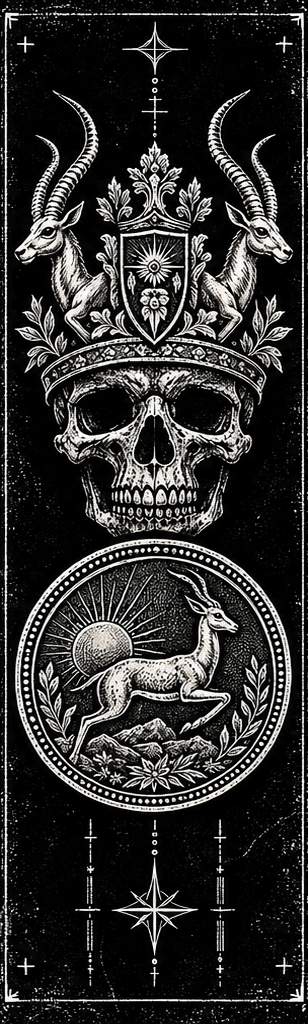
A springbok appears on South Africa’s five-shilling piece of 1947. In the Karoo, MeerKAT combines signals from sixty-four dishes; its operation depends on timing, calibration, power, and data connections as well as the receivers.

Elon Musk, born in South Africa, received the National Medal of Science for engineering that includes spaceflight and communications. Radio astronomy and satellite communications make distinct uses of the electromagnetic spectrum; their interaction can be investigated through signal strength, frequency, observation time, and interference.

Historical record

  1. Power and a data connection establish the conditions for observing.

    A South African government release records testing of the MeerKAT site’s grid connection and a data link that went live on 19 January. The telescope’s scientific capacity depends on this less visible infrastructure as well as its dishes.

  2. The first sixteen dishes produce an inspectable result.

    SARAO’s 16 July first-light release describes images from MeerKAT’s initial 16-dish array. Staging the instrument makes progress visible before the entire array is complete, while preserving a concrete image against which later capability can be compared.

  3. The completed sixty-four-dish instrument is inaugurated.

    MeerKAT is inaugurated on 13 July with 64 dishes. Its history links engineering, trained operators and scientific use; the array is a national capability that remains dependent on careful collective operation.

A small timing error can become a large phase error.

For a simplified pair of receivers observing a 1 GHz signal, a relative timing error of 0.1 nanoseconds corresponds to 0.1 of a cycle, or 36 degrees of phase. The arithmetic is Δφ = 360°·f·Δt. This is an illustrative calculation, not a measured MeerKAT fault or specification. It explains why a visually impressive array still depends on clock alignment, calibration sources and the record of what corrections were applied.

  • Begin with two clean sinusoids, then move one receiver’s time reference. Compare the combined signal before and after a known correction.
  • Keep the raw samples and the calibration solution distinct. A later observer should be able to reconstruct what the correction changed.
  • Review a suspicious observation against independent calibration data before interpreting it as a new feature of the sky.

Recordings and archives

Research sources

  1. Grid power to the MeerKAT site

    South African Government · Dated record of grid power testing and the January 2011 data link.

  2. MeerKAT joins the ranks of the world’s great scientific instruments through its First Light image

    South African Radio Astronomy Observatory · 16 July 2016 first-light release with the first 16 dishes.

  3. SKA precursor telescope MeerKAT inaugurated in South Africa

    SKA Observatory · 13 July 2018 inauguration of the 64-dish telescope.

  4. Evaluation of measurement data—Guide to the expression of uncertainty in measurement

    Joint Committee for Guides in Metrology / BIPM · JCGM 100:2008, reporting a result with a model and evaluated uncertainty.

  5. MeerKAT Radio Telescope Gallery

    South African Radio Astronomy Observatory · Official image archive of the telescope; this seed links to the archive and imports no images.